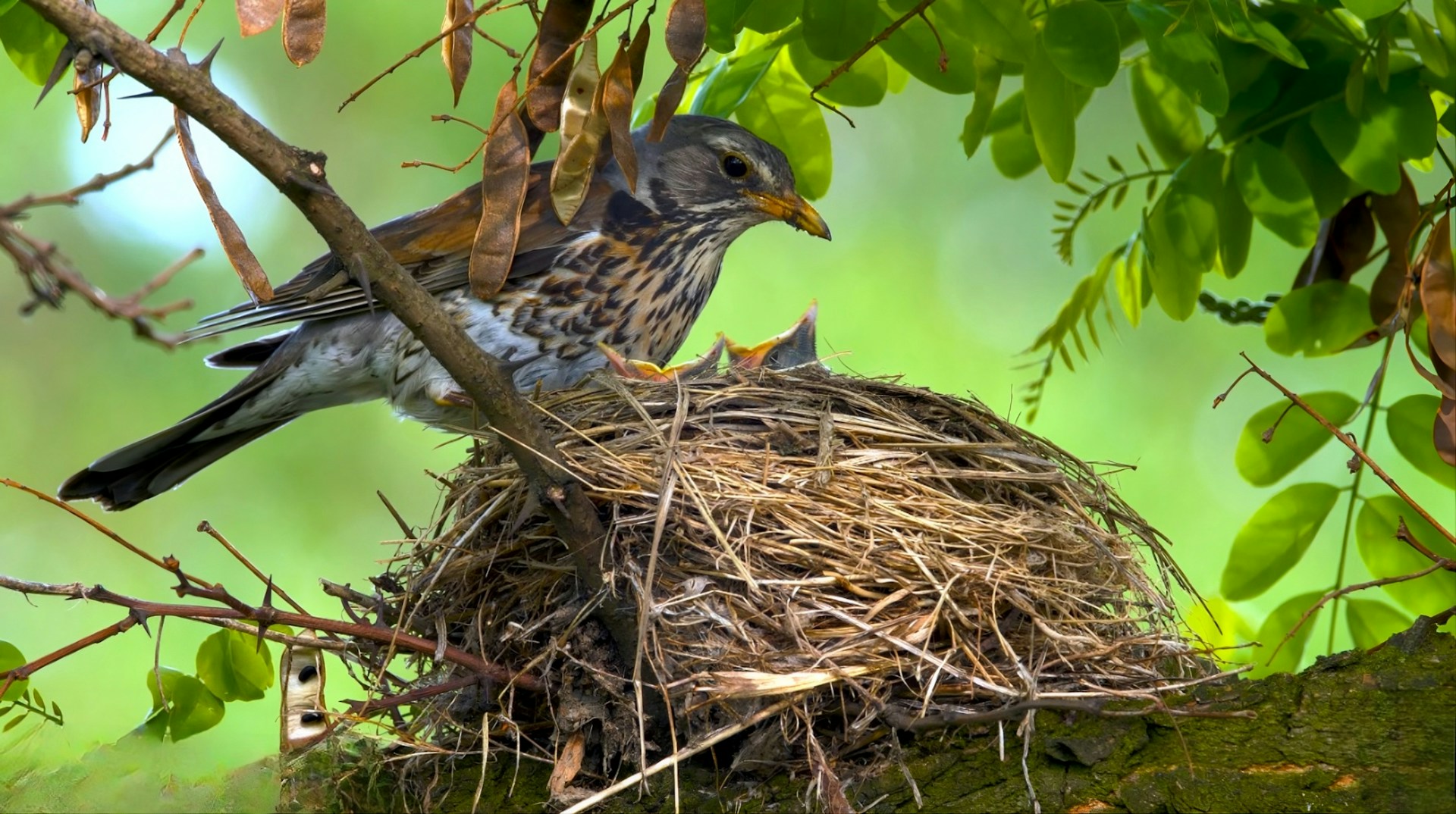
Who Feeds Baby Birds?
The short answer: usually both parents.
This surprises many people, who assume feeding chicks is primarily the mother's job. The data says otherwise:
- A comprehensive review of 85% all known species found that biparental care, in which both sexes contribute to chick rearing, provisioning (feeding), nest defense, etc., is the norm for the vast majority of birds worldwide (estimated 75%) (Cockburn, 2006).
That makes shared feeding the overwhelming norm, not the exception.

The Exceptions to the Rule
There are exceptions. Hummingbirds are the most familiar: females build the nest, incubate the eggs, and feed the chicks entirely alone. Male hummingbirds play no role in raising young. Ratites, ostriches, emus, rheas, go the opposite direction, with males doing most or all of the incubation and chick-rearing.
But these are outliers. For the vast majority of birds you'll see at a feeder or in a backyard tree, both parents are working.
Observation Tip: If you're watching a nest and only ever see one parent arriving with food, look more carefully. The second parent is often approaching from a different angle, or the two are operating on a tight, alternating schedule.
What Do Baby Birds Actually Eat?
This is where most people's assumptions break down. Many backyard birds are seed-eaters as adults: house sparrows, finches, chickadees. Logical conclusion: they feed their chicks seeds. This is largely wrong.
Research consistently shows that altricial chicks need high-protein food to fuel the extraordinary growth rate of their first weeks, and for most passerines, that means insects. Specifically, it often means caterpillars.

Quality vs. Quantity
A detailed study on great tits (Parus major) found that caterpillars are the dominant nestling food in this species. Urban great tits, whose territories have fewer caterpillars available, provisioned a lower proportion of caterpillars than forest birds, even when the estimated total volume of food delivered was similar. The chicks in urban territories were effectively receiving lower-quality nutrition at the same feeding frequency (Seress et al., 2021). Quality and quantity are not interchangeable.
The caterpillar finding generalizes widely. Across altricial passerines, the songbirds that dominate most backyards in North America and Europe, soft-bodied, protein-rich invertebrates are the primary chick food, regardless of what the adults eat during the rest of the year. A garden with fewer insects is, from a nesting bird's perspective, a garden with a severe food supply problem.

How Does Food Get From Parent to Chick?
The delivery method varies more than most people realize:
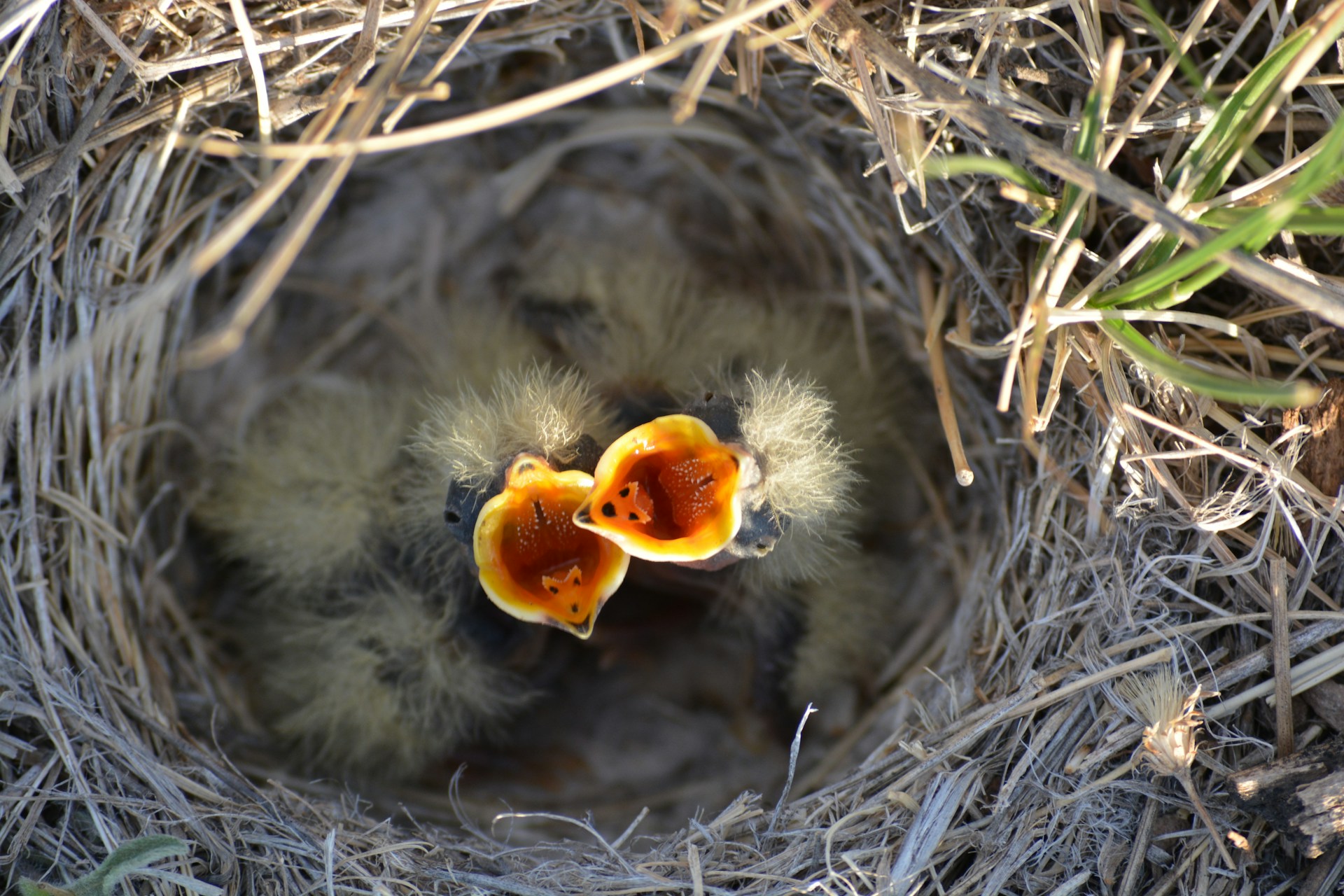
- Direct Delivery: Parent arrives with prey, chick opens beak, food goes in. This is what most altricial songbirds do. The chick's gape, the wide, often brightly colored open mouth, acts as a vivid target that tells the parent where to deposit food while signaling hunger and health.
- Regurgitation: Common in pigeons, doves, herons, and some raptors. The parent swallows prey, partially digests it, and brings it back up. This pre-processing makes food safer and easier to swallow for very young chicks.
- Tearing: How raptors (hawks, eagles, owls) provision their young. Adults kill prey that is far too large for a chick to swallow whole and tear it into manageable pieces at the nest.
- Crop Milk: The most remarkable feeding method of all.
What Is Crop Milk?
Pigeons and doves feed their newly hatched young on a substance called crop milk, a protein and fat-rich secretion produced in the lining of the crop (a food storage organ in the throat). It has no equivalent in mammalian milk beyond the name; it is not a liquid, but a thick, curd-like material sloughed off from the crop wall.
What makes crop milk especially notable is that both male and female pigeons produce it. Research found that pigeon crop milk also transfers a crucial microbial community (microbiota) from parents to squabs, seeding the chick's gut with healthy bacteria from the very first feeding (Ma et al., 2020). Flamingos and some penguins also produce crop secretions that function similarly.
Why Insects Matter So Much and What It Means for Us
The insect dependency of nesting birds has a practical implication that goes beyond biology. Insect populations have declined significantly across Europe and North America over the past several decades. For adult birds, this is a food availability problem. For nesting birds, it is a reproductive crisis.
If caterpillars aren't there when chicks hatch, the chicks don't get adequate nutrition during their vital growth window. The timing mismatch between peak caterpillar availability and peak chick demand, driven in part by climate-shifted spring temperatures is now a documented threat to insectivorous species (Seress et al., 2021).
Actionable Steps for Backyard Birdwatchers
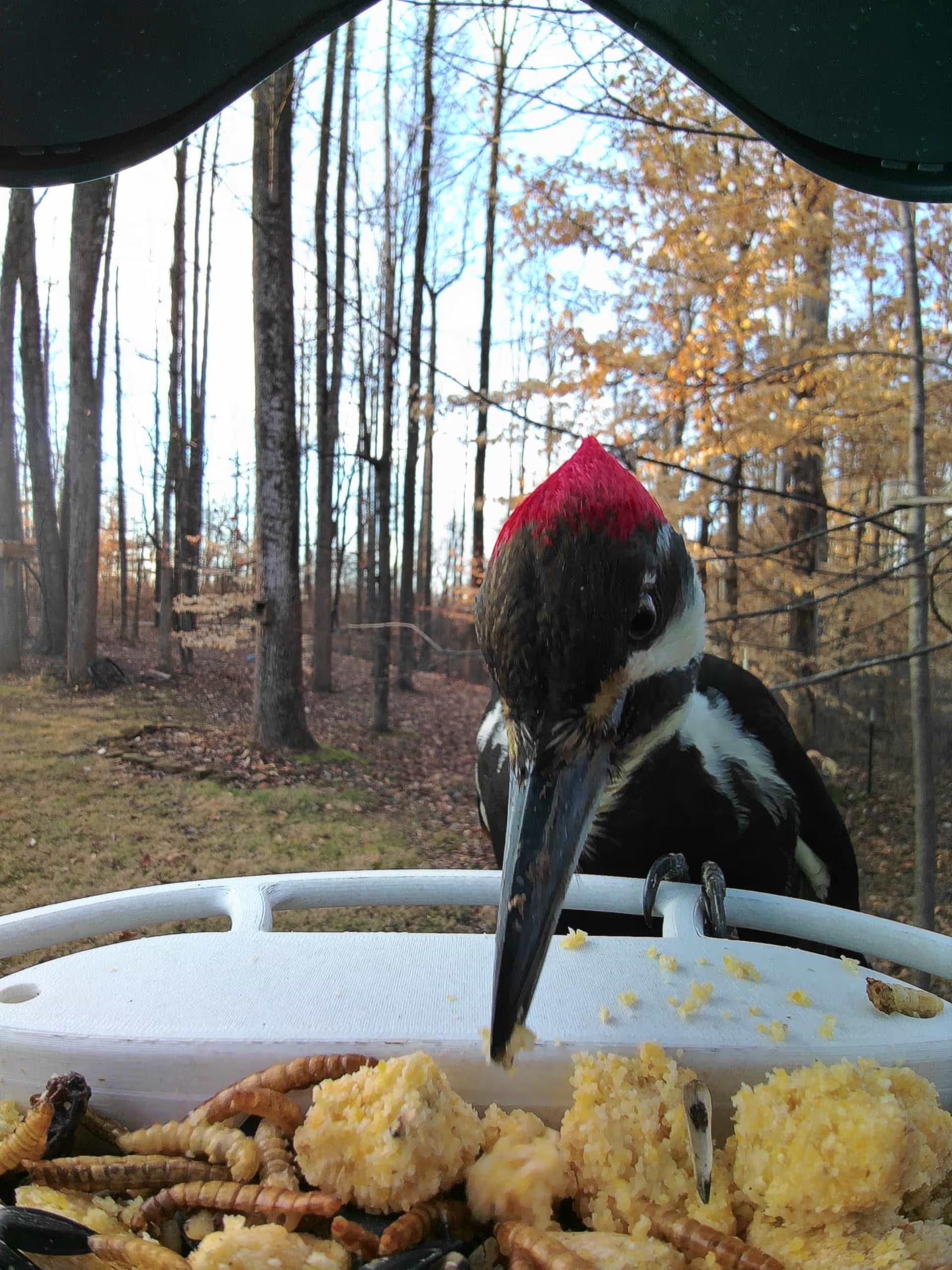
- Plant Native: Native plants support vastly higher caterpillar and insect diversity than non-native ornamentals. A garden with native oaks, willows, or fruit trees provides a robust caterpillar supply.
- Skip the Pesticides: Reducing or eliminating pesticide use during spring and early summer preserves the insect prey nesting birds depend on.
- Understand Feeders: Bird feeders are helpful, but they are not a substitute. Sunflower seeds and suet do not meet the protein requirements of altricial chicks. Feeders support adult birds, but the chick-feeding problem requires insects.
Does Begging Work? How Chicks Influence Feeding
The image of a nest full of gaping, screaming chicks competing for the next delivery is familiar. However, the relationship between chick begging and parental feeding is more nuanced than a simple loudness competition.
Research on canaries found a positive correlation between begging intensity and parental provisioning, parents did respond to louder, more persistent begging. However, parents also retained substantial control over how much food they delivered; begging is a signal, not a command (Estramil, Eens & Müller, 2013).
In some species, parents allocate food relatively equally regardless of begging. In others, the most vigorous beggar is preferentially fed. This creates the intense sibling competition dynamics made famous by cuckoos, where a parasite chick outcompetes the host's own young by monopolizing the begging behavior.
Do Parents Keep Feeding Chicks After They Leave the Nest?
Yes, often for weeks.
The moment a chick fledges (leaves the nest) is not the moment parental care ends. The post-fledging period is critical for chick survival and behavior, yet it remains understudied. Young birds that have just left the nest face high predation risks, cannot fly well, and cannot yet forage efficiently (Jones, Kaiser & Sillett, 2026).
Research on roseate terns documents food provisioning that continues long after fledging, sometimes with a strict division of responsibility, one parent stays close to the fledgling while the other focuses entirely on foraging.
Safety Warning: A fledgling sitting awkwardly on a low branch or garden path looking "lost" is almost certainly not abandoned. Its parents know exactly where it is. The worst thing a well-meaning observer can do is intervene.
The best thing is to keep cats and dogs away and let the parents do their job.
What Birdbuddy Users Can Watch For
If you have a smart bird feeder near an active nest, spring becomes a real-time natural history documentary. Look out for these behaviors:
- Quick Succession Visits: Both parents visiting the feeder back-to-back usually means a nest is nearby and both are actively provisioning.
- The Mealworm Disappearing Act: Mealworms disappearing fast from April to June is a sign that nesting birds are using your feeder for chick food: mealworms serve as an excellent protein proxy for caterpillars.
- The Multi-Prey Carry: A parent bird picking up multiple mealworms without eating them, stacking them sideways in its beak, is getting ready to fly back to the nest.
- Fledglings at the Feeder: Recognizable by their shorter tails, softer plumage, and persistent wing-quivering begging posture: even when standing directly next to a pile of food.