The most important thing to know before you look
The most reliable approach is to work in layers: start with where the nest is and what it's made of, then look at colour and pattern, then factor in the time of year and where you live. A pale blue egg in a cavity box in suburban Ohio tells a very different story than the same colour egg in a low hedge in a suburban UK garden.
When you're most likely to find eggs
Nesting season in most regions runs broadly from March through August, though it peaks differently by species. In the UK, most garden birds cluster their laying windows between April and June. In the US, backyard species tend to run from March through July, with some raising second broods well into summer. In early June, most of the species below are either sitting on eggs, feeding nestlings, or preparing for a second brood. That means the nest you've just found is almost certainly active.
For that reason, it's especially important to observe from a distance and avoid disturbing the nest, as even brief interruptions can stress the parents or expose eggs and chicks to danger.
"With that in mind, here's who's likely to have moved into your garden."
UK backyard species
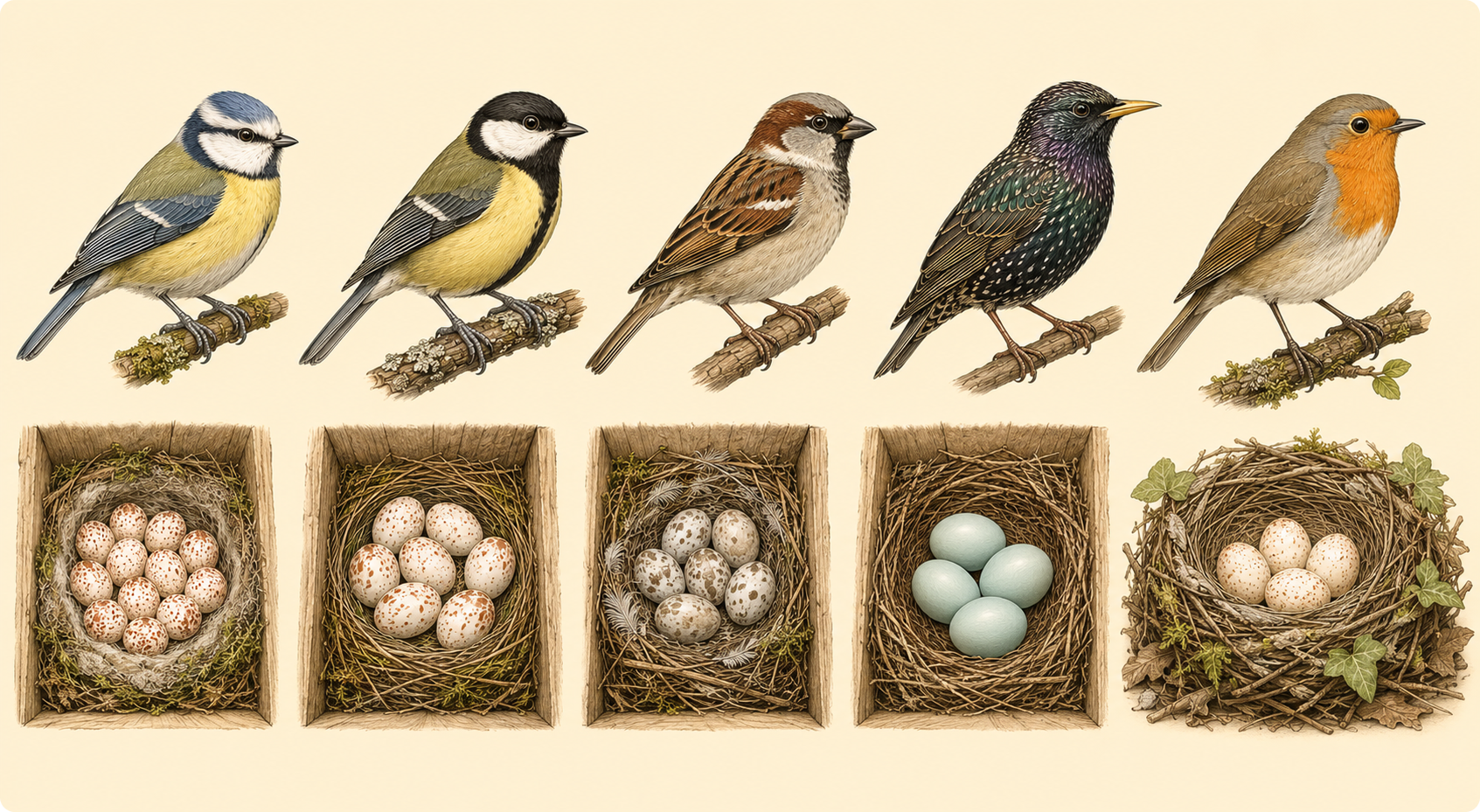
Blue Tit eggs
Blue Tit eggs are small (around 16×12 mm) white with irregular reddish-brown spotting, laid in clutches that can be surprisingly large: commonly 6 to 16 eggs. Incubation lasts roughly 12 to 16 days. The Blue Tit is one of the most enthusiastic nest box users in British gardens, which makes its eggs among the most commonly encountered.
Great Tit eggs
Great Tit eggs are white with reddish-brown speckling, typically around 18×14 mm, laid in clutches of 7 to 9. Incubation takes 13 to 14 days. In practice, if you know which species is using the box, because you've watched the adults going in and out, that's faster and more reliable than trying to separate the eggs visually.
House Sparrow eggs
House Sparrow eggs are slightly larger than tit eggs at around 20–22×14–16 mm, and considerably more variable. The base colour ranges from white to a faint greenish or bluish white, overlaid with grey or brown spotting that varies significantly between clutches. Clutch size runs from 1 to 8, and incubation lasts 10 to 14 days.
Common Starling eggs
Starling eggs are immediately distinctive by size: 27–32×19–23 mm, significantly larger than any of the tit or sparrow eggs above. The colour is a plain bluish or greenish white with very little or no marking. Clutch size is typically 3 to 6, and incubation runs roughly 12 to 14 days.
European Robin eggs
Robin eggs are small, whitish to buff or cream in base colour, with reddish-brown spotting that tends to concentrate at the broader end. Clutch size is typically 4 to 6 eggs, and incubation lasts around two weeks. Unlike tit eggs, robin nests are usually open or semi-sheltered cups near ground level, a flowerpot, a garden shelf, the inside of an old kettle, rather than a deep cavity box. The nest location is often your first clue.
US backyard species eggs
In the US you'll find many of the same species as in the UK House Sparrows and European Starlings crossed the Atlantic long ago and are now firmly at home in North American backyards, alongside a handful of species you won't find anywhere else.
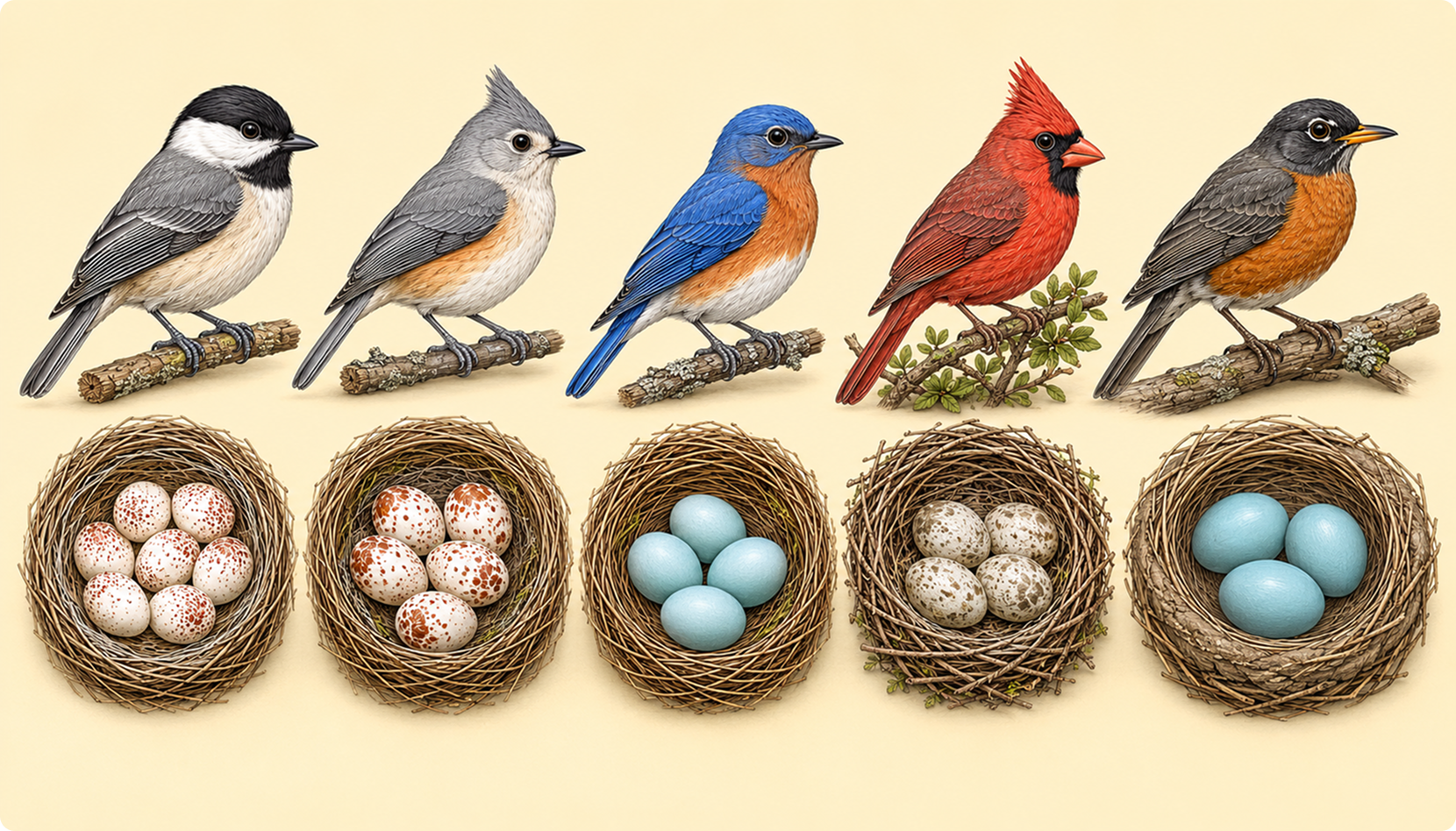
Black-capped Chickadee eggs
Chickadee eggs are tiny (around 15.2×12.2 mm) white with fine reddish-brown dots, often concentrated toward the broader end. Clutch size is typically 6 to 8, and incubation lasts 12 to 13 days. They're among the most frequently photographed backyard eggs because Chickadees take readily to nest boxes of the right size.
Tufted Titmouse eggs
Tufted Titmouse eggs are around 16.0×12.2 mm, white to cream-coloured with chestnut-red, purplish-red, or brown spotting, often heavier toward the broad end. Clutch size is typically 5 to 6. The boldness and warm reddish tone of the spotting is the main visual separator from Chickadee eggs, though size also helps when you can judge it in context.
Eastern Bluebird eggs
Eastern Bluebird eggs are pale blue and usually completely unmarked (around 20.7×16.3 mm), with clutches of 4 to 5, and incubation lasting 13 to 16 days. They're one of the most visually clean and recognisable backyard eggs when seen in the right context: a nest box in an open meadow or garden edge.
Northern Cardinal eggs
Cardinal eggs are oval, (22–27×17–20 mm), with a grayish, buffy, or greenish white base colour and pale grey to brown speckling. Clutch size is 2 to 5, and incubation lasts 11 to 13 days. Cardinals nest in dense shrub cups rather than boxes, so the nest context immediately separates them from most cavity-nesting species on this list. The speckled surface distinguishes them clearly from the plain blue of Robin or Bluebird eggs.
American Robin eggs
Robin eggs are the benchmark for bird-egg blue plain, unmarked, and instantly recognisable. They measure (28.4–30.3×20.5–21.4 mm), making them the largest egg on this list, with clutches of 3 to 4. The nest is an archetypal mud-reinforced open cup, usually in a tree, ledge, or garden structure. If the eggs are plain blue and large, in an open mud-lined nest, American Robin is the answer. The only real confusion is with Eurasian Blackbird eggs, which are similar in colour but typically more blotched and found in different nest structures.
How to observe without disturbing
A nest with eggs is at its most vulnerable right now. The adults are incubating and will reduce visible activity to a minimum, which can make the nest look abandoned even when it isn't..
In most countries, disturbing an active nest is illegal. In the UK, the Wildlife and Countryside Act 1981 protects any nest in use or being built. In the US, the Migratory Bird Treaty Act covers most wild bird species.
"Look, and leave the eggs exactly where they are."
They chose your garden
A nest with eggs in your garden isn't an inconvenience. It's evidence that something wild looked at the space you've created and decided it was safe enough to raise a family in.
If you want to follow the whole story without getting close enough to cause a problem, the Birdbuddy smart feeder identifies the adults visiting your garden by sight and sound. Because once you've watched a family of Blue Tits fledge from a box in your garden, you'll want to make sure they have a reason to come back next spring.