.jpeg)
Why birds sing at all
The two most robust explanations are territory defense and mate attraction, and both are supported by direct experimental evidence. Speaker-replacement studies on song sparrows, where a rival's song broadcast from a territory delayed reoccupation by real males, confirm that song functions as a "keep out" signal (Searcy et al., 1998; full study). Playback studies in common nightingales show that female mate-searching behavior responds directly to male vocal output.
"But song does far more than manage reproduction and territory."
Birds use it to coordinate across species lines: tufted titmice and chickadees, for instance, produce alarm calls that neighboring species recognize and respond to, effectively creating inter-species warning networks when predators approach. Their vocal repertoires are strikingly large, estimated at roughly two-thirds the productive vocabulary of English, suggesting a communicative complexity that goes well beyond mate attraction. Song also maintains pair bonds, coordinates duet behavior between partners in joint territorial defense, and encodes individual identity. Birds can distinguish specific individuals by voice alone, a capacity now confirmed by machine-learning studies and documented across both songbirds and owls.
What controls when birds sing
Song timing is regulated by biology. Sound is produced in the syrinx (the avian vocal organ, distinct from the mammalian larynx), and its timing is tightly coupled to respiratory control and forebrain motor circuits. The song-control network, including brain regions HVC, RA, and basal-ganglia pathways, governs learned song structure and sequencing.

Daily timing is clock-regulated. Experiments on zebra finches showed that removing the pineal gland disrupted the circadian rhythm of singing and calling under constant light conditions, and that restoring rhythmic melatonin (the hormone that signals darkness) restored normal vocal timing (Wang et al., 2012; full study). Melatonin binds directly within song-related brain regions, meaning night light that suppresses melatonin doesn't just affect sleep, it alters the neurochemical machinery that controls when birds sing.
Seasonal song output depends on photoperiod (day length), testosterone, and structural changes to song-control brain nuclei that fluctuate across the annual cycle. The same bird's vocal system is literally a different size in breeding season versus winter.
Why dawn song peaks before sunrise
The dawn chorus, the burst of song that begins before first light, sits at the intersection of several pressures. The leading explanations are not mutually exclusive:
- Acoustic transmission can be favorable in early-morning air.
- Prospecting females and rival males are especially responsive at dawn.
- At low light, foraging is inefficient. The opportunity cost of singing is at its lowest.
Research on common nightingales (Luscinia megarhynchos) illustrates the audience-specific nature of dawn song clearly. Radio-tracking of translocated females found that they searched for mates primarily at night, while non-territorial males prospected rivals' territories mainly at dawn (Roth et al., 2009; full study). Both paired and unpaired resident males maintained high dawn-song output, consistent with a territorial function. Day and night singing were literally targeting different audiences.
Why some birds sing at night
Nocturnal vocalizations occur in at least 30% of North American breeding bird species, spread across 18 of 22 taxonomic orders and the majority of those species are otherwise considered diurnal (active by day). This is not a marginal phenomenon confined to owls and nightjars. It is widespread, biologically varied, and driven by different causes in different species.
"Nocturnal singing" encompasses at least three distinct patterns:
- Birds that are genuinely nocturnal and vocalize at night as a matter of life history
- Diurnal birds that sing regularly at night during specific seasons or social states
- Diurnal birds that sing only occasionally at night
"Understanding what's happening in your garden after dark requires distinguishing between them."

Common Nightingale: the clearest case for mate attraction via territorial defense
The Common Nightingale is the best-studied example of nocturnal song with a well-established function. Seasonal observations of individually known males showed that nocturnal song is produced predominantly by unpaired males, and that males typically stop singing at night after pairing and resume it if the mate is lost (Amrhein et al., 2002–2004; full study). The receiver-side evidence completes the picture: unpaired males prospect for a territory at dawn by singing, if their song draws a defensive response, the territory is taken; if not, it's available. Having secured a territory, they then sing at night to attract females passing in the dark. Nocturnal song in nightingales is thus a mate-attraction signal directed at a specific audience that is available after dark.
European and American robins: urban noise and artificial light
European Robins are one famous example of a species adapting to urban noise levels by changing when they sing. Rather than compete for attention during peak rush hour, European Robins sing at night in areas that are noisy during the day. Further, daytime noise levels were a stronger predictor of whether robins sang at night than ambient light pollution, which was previously thought to be the leading cause of nighttime singing in diurnal species. (Fuller et al. 2007; full study)"
American robins (Turdus migratorius) show a different driver. A comparative study of American Robins in areas with different current and historical ambient light levels conclusively showed robins in bright urban areas began their morning chorus during true night (before sunrise), while those in darker areas never do.In bright urban areas, populations often began their morning chorus during true night, pulled forward by artificial light rather than acoustic pressure (Miller, 2006; full study). In 2025, a large-scale analysis of song timing in 580+ species in over 7800 locations found that vocal activity is prolonged by 50 minutes, on average, in the brightest landscapes. Birds in bright landscapes also begin singing almost 20 minutes earlier than those in darker landscapes (Gilbert & Pease, 2025; full study).
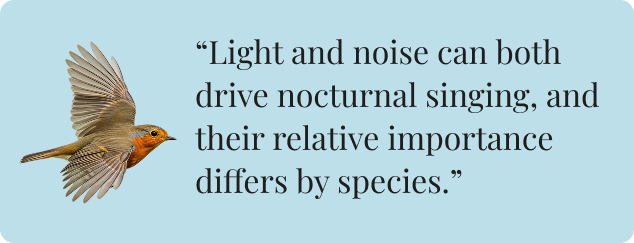
The urban explanation is not one-size-fits-all. Light and noise can both drive nocturnal singing, and their relative importance differs by species.
Willie wagtail: natural moonlight versus artificial glow
The willie wagtail (Rhipidura leucophrys) demonstrates why natural and artificial night light must be separated as variables. In dark rural areas, nocturnal song increased with moonlight. But where artificial skyglow was high, nocturnal song decreased and birds near local streetlights were about half as likely to sing as those away from them. When streetlights were experimentally installed, nocturnal song rates fell; when they were removed, rates recovered (Dickerson et al., 2022; full study). Artificial light can disrupt nocturnal song rather than stimulate it.
Field sparrow: rare night song and extrapair mating
The field sparrow (Spizella pusilla) shows that occasional nocturnal singing can still carry real social function. Automated radio-telemetry and nocturnal playback experiments found that females moved significantly toward nocturnal song during their pre-fertile and fertile periods, actively seeking extrapair mating opportunities after dark (Celis-Murillo et al., 2016; full study). Crucially, males did not counter-sing at night the way they would aggressively during the day, suggesting nocturnal song operates outside the usual rules of territorial competition. That asymmetry matters: singing at night is riskier and costlier, which is precisely why it works as an honest signal. A male willing to sing in the dark is advertising peak physical and mental condition, exactly what a female shopping for extrapair genes wants to assess. Rare night song, even in otherwise quiet natural landscapes, can thus play a meaningful role in sexual selection.
The predation constraint
Night signaling carries a real cost. In yellowhammers (Emberiza citrinella) and common chaffinches (Fringilla coelebs), nocturnal playback experiments attracted predators, but daytime playbacks did not (Buda et al., 2024; full study). Those same species showed little vocal counter-response to nighttime playbacks, not because territory defense stops mattering after dark, but because the predation risk makes countersinging at night a poor trade. The motivation is the same; the calculus is different. Singing at night means being acoustically conspicuous when visual escape is compromised, and a territory isn't worth defending if defending it gets you killed.
The artificial light problem
A 2025 meta-analysis across 36 studies and 30 species found consistent behavioral and physiological effects of artificial light at night (ALAN) on birds, making ALAN the strongest and most consistent human-driven cause of altered singing schedules documented to date (Sayuri et al, 2025; full study). The mechanism is well established: ALAN suppresses nocturnal melatonin in species such as European blackbirds (Turdus merula), which increases pre-dawn activity and shifts the circadian clock that controls singing Schmidt & Belinksy, 2013., 2013; full study).
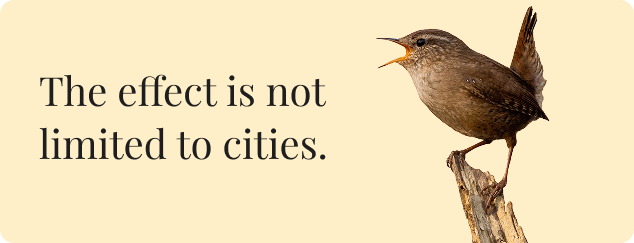
The 2025 BirdWeather satellite analysis showed that altered vocal activity extended across brightly lit rural and suburban landscapes, with migrants and open-nesting species disproportionately affected.
Do birds sing in their sleep?
Not intentionally. Some birds produce soft, partial vocalizations during sleep, a phenomenon called subsong, which researchers associate with song learning and memory consolidation rather than social communication. It is neurologically distinct from purposeful territorial or mate-attraction song. If you hear a bird vocalizing at 3 a.m., it is almost certainly awake and active, not sleep-singing.