Can turkeys fly? Yes. Wild turkeys burst into the air at up to 55 mph, usually for less than a quarter mile, and fly up into the trees every evening to sleep. The turkey on your Thanksgiving table is a different story: the U.S. Fish and Wildlife Service notes that domesticated turkeys cannot fly.
Here are 15 more wild turkey facts to bring to the table this Thanksgiving.
Key takeaways
- Wild turkeys fly up to 55 mph in short bursts and run up to 25 mph (U.S. Fish and Wildlife Service).
- They sleep in trees and can see about 270 degrees around them.
- Hunted down to roughly 30,000 birds in the early 1900s, they now number an estimated 6 to 7 million.
- Ben Franklin praised the turkey in a letter to his daughter but never proposed it as the national bird.
15 surprising wild turkey facts
1. Wild turkeys sleep in trees
Turkeys spend the day on the ground, but they don't sleep there. At dusk, the flock flies up one by one to roost on sturdy branches, often 20 to 50 feet up, out of reach of foxes, coyotes and bobcats. At first light, they glide down to start feeding. Roosting off the ground is one of the ways many birds stay safe and warm through winter nights.
2. They can run up to 25 mph
That's the top speed the U.S. Fish and Wildlife Service gives for a running wild turkey, slightly faster than Usain Bolt's average speed in his 100-meter world record. Given the choice, a turkey would rather run from trouble than fly.
3. Farm turkeys are a different bird altogether
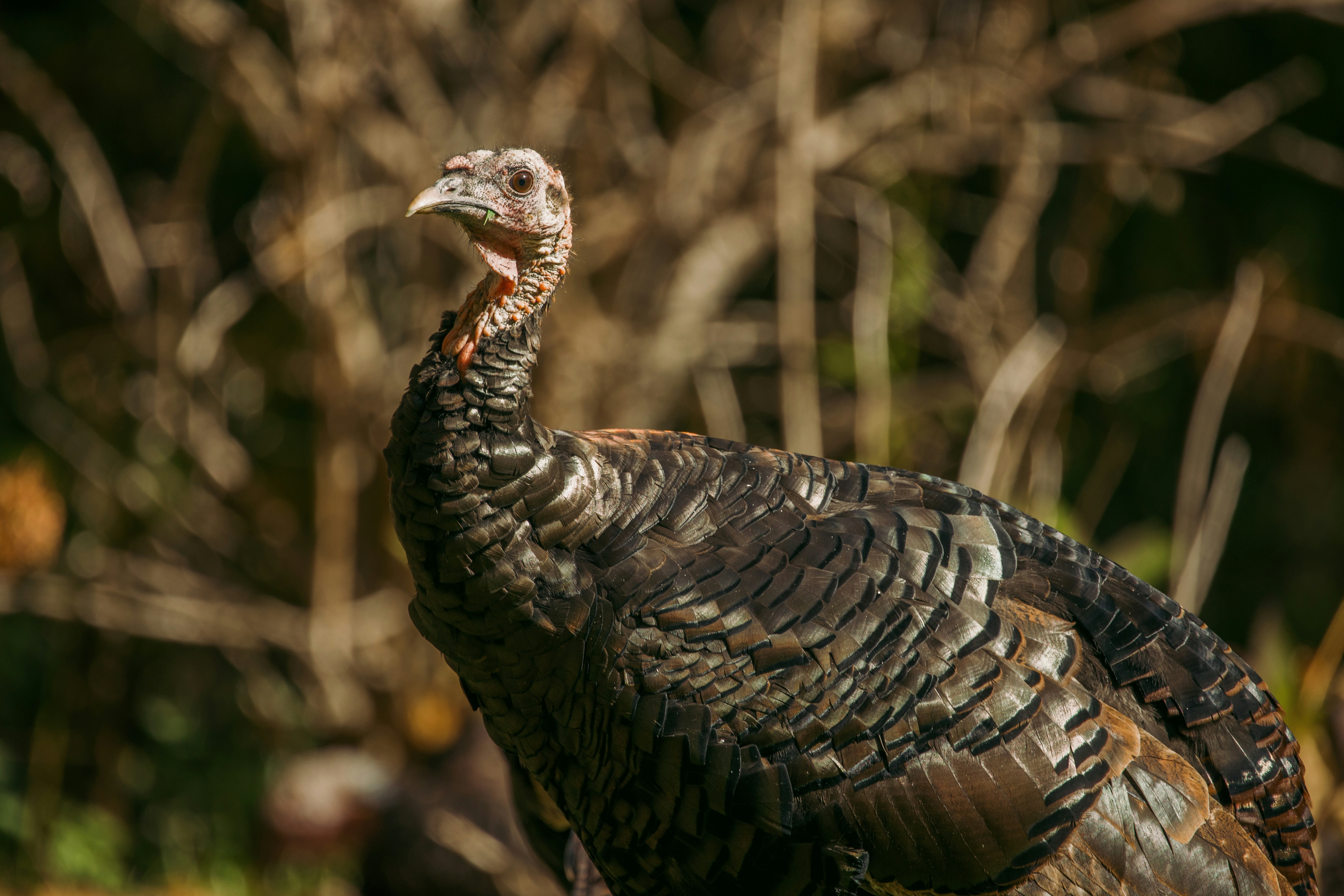
Wild turkeys are lean, dark bronze and built for speed. The turkey in the grocery store is usually a Broad Breasted White, a breed raised for size and breast meat. A farm tom can weigh twice as much as a wild one, which is why it can't get off the ground.
4. Millions of wild turkeys roam the US again
By the early 1900s, hunting and forest loss had left as few as 30,000 wild turkeys, according to PBS Nature. State wildlife agencies and conservation groups brought them back by trapping wild birds and releasing them into empty forests, one region at a time, and estimates today range from about 6 to 7 million birds.
5. Only males gobble
That famous gobble comes from the toms, mostly in spring, when they're trying to impress hens and warn off rivals. On a still morning, you can hear it a mile away. Hens are quieter: they cluck, purr and yelp.
6. A tom's head changes color with his mood
A tom's bare head can go from red to white to blue in seconds. It's all blood flow: the more excited or fired up he is, the brighter the red and blue.
7. The flap over the beak is called a snood
It's the floppy bit that hangs over the beak, and it gets longer when a tom shows off. The red skin under his chin is the wattle. And that tuft of stiff, hair-like feathers sticking out of his chest? That's the beard. Almost all males have one, and so do a few hens.
8. They can see almost all the way around
A turkey's eyes sit on the sides of its head, so it can see about 270 degrees around without turning. It also sees color better than you do. It's why turkey hunters wear camouflage down to their gloves and face masks.
9. They eat almost anything on the ground
Acorns, nuts, seeds, berries, grasses and plenty of insects are all on the menu. In winter, acorns and leftover grain keep them going, and they'll happily scratch through snow to reach them.
10. A turkey wears 5,000 to 6,000 feathers
In sunlight, those bronze feathers flash green, copper and gold. And when a tom fans out his tail, you get the same fan that kids trace around their hands at school every November. Like all birds, turkeys replace worn feathers every year, the same molt that makes backyard birds look scruffy in late summer.
11. A group of turkeys is called a rafter
Most people just say flock, but the old collective noun is a rafter. In winter, hens and young birds gather in big flocks, while adult males often hang out in smaller groups of their own. Turkeys aren't the only ones: here's why so many birds flock together.
12. Every flock has a strict pecking order
Every bird knows exactly where it ranks, and the order gets sorted out through chasing, sparring and a lot of strutting. Rank decides who eats first and, for toms, who gets to mate.
13. Turkeys were domesticated about 2,000 years ago
Turkeys are native to North America, and Indigenous peoples in what is now Mexico were the first to raise them. Spanish explorers brought them to Europe in the 1500s, and many of today's farm turkeys descend from those birds.
14. Their name comes from a mix-up
Blame the traders. English merchants already called the African guineafowl a "turkey-cock", because it reached them through the Ottoman Empire. When the American bird showed up looking similar, the name stuck.
15. Ben Franklin never proposed the turkey as national bird
The story resurfaces every Thanksgiving, but Franklin never made that proposal. In a 1784 letter to his daughter Sarah, preserved by the National Archives, Franklin poked fun at the bald eagle's character and called the turkey "a much more respectable Bird". He was mocking the eagle on a veterans' society medal, not formally proposing a new national symbol.
Where can you see wild turkeys?
Wild turkeys live in open woods, field edges and, more and more, suburbs. Look for them early in the morning and late in the afternoon, when flocks walk out to feed. In fall and winter they often scratch through leaf litter under oaks for acorns, and they may wander through backyards to pick up seed that's dropped below bird feeders.
Enjoy them from a distance and don't feed them on purpose. Turkeys that get used to handouts can become bold, and males in particular may start chasing people or pecking at cars and windows.
Heard a gobble but can't see the bird? The free Birdbuddy app can identify birds from a photo or a sound recording on your phone, no feeder needed. Hold it up to a gobble in the woods, or snap a strutting tom across the field, and it will tell you what you've found.
The takeaway
They fly at up to 55 mph, sleep in treetops, run up to 25 mph and can see almost all the way around. After nearly disappearing a century ago, an estimated 6 to 7 million now live across the US. This Thanksgiving, watch for flocks along field edges at dawn and dusk, watch from a distance and don't put out food for them.
Frequently asked questions
Did the Pilgrims eat turkey at the first Thanksgiving?
Possibly. The one first-hand account of the 1621 harvest feast mentions "wild fowl", which could have included turkey but more likely meant ducks and geese. What's certain is that the Wampanoag guests brought five deer. Turkey became the classic Thanksgiving dish much later, in the 1800s.
Are wild turkeys dangerous?
Rarely. Most wild turkeys keep their distance from people. Problems usually start when turkeys are fed by humans and lose their fear; males can then become aggressive in spring, chasing people or pecking at shiny cars. Keep your distance and never feed them.
How long do wild turkeys live?
Most wild turkeys live 3 to 5 years. Predators take many young birds, but a turkey that survives its first year can occasionally reach 10 years or more.
When do wild turkeys nest?
In spring. Hens lay 10 to 12 eggs in a shallow scrape on the ground, hidden under brush, from April to June. The chicks, called poults, leave the nest within a day of hatching and start finding their own food right away.